# On designing meaningful products in the AI Era
_Date: 14-11-2026 , Tags:_ #AI #ProductManagement #ProductDesign #Skeuomorphism #MalleableSoftware #EthicalTech
Author: Adriano Fontanari, 14 November 2026
> [!summary] TL;DR
> - In 70 years, interfaces went from utility (switches, command lines) to real objects (Magic Cap, iOS 6) to flat screens distant from our world.
> - Products start by satisfying users, then optimise for revenue and enshittify. Past the optimal utility ratio, more time spent is negative value.
> - AI smooths the cliff between using software and building it: users can now rebuild the tools that fail them (malleable software).
> - The next job of design is meaning: products that make users feel at home. Casa is my attempt.
> - I introduce the five principles: protect the core, respect the utility ratio, make it malleable, design for meaning, earn trust and never exploit it.
In fall 2019, my iPhone 5s broke and I was happy.
No more notifications, people tagging, commenting or apps distracting me for a few weeks while Apple was repairing it.
What happened in the following years is that my approach to how I see and use technology radically shifted.
I went from being a power user craving to jailbreak the iPhone firmware and test the latest software betas (still happy to be one of the 1Password Italian translators, to get early access to 1Password 4) to building up my operating system.
In 2021, Markdown started regaining popularity with Obsidian. Obsidian, which later became widely successful, was an epiphany to me. A private piece of software that is a blank slate for your imagination.
In the following two years, I built my second brain to the extent that it became much more: an OS that also tracked my wellbeing and finances. The paucity of such tools made me willing to share it with the rest of the world, named [YourOS](https://youros.adrianofontanari.com/).
Then AI came, and another epiphany too: the possibility to build delightful and functioning digital experiences via vibe coding.
In less than a year, I went from GUIs to CLIs and back to a GUI. Incidentally, what happened in the past months is that I built Casa, a personal OS that, I only found out now, resembles Magic Cap, the OS of 1994, before smartphones went mainstream.
Though, the consideration is much more profound, and it touches upon what I believe went wrong in the software industry (there was no escape) in the past 30 years, and how we can rethink technology as an enabler of us rather than a product optimised only for retention and revenue.
Before getting into the product principles that I believe constitute modern ethical product management, and that the broad audience should also consider, let's have a brief excursus on how UIs evolved in the past 70 years. It will not be exhaustive, but the goal is to give a taste.
## 70 years of interfaces
The Setun was a **balanced ternary computer** developed at Moscow State University in 1958.
Flip the switches, feed the punched tape. Designed to perform the computations of a group of highly educated mathematicians and engineers.
![[Casa essay - Setun 1958.png|600]]
*Source: Wikipedia*[^1]
If you want to test its successor, the Setun-70 (1970), you can find an emulator online.[^2] You will see how straightforward it was, no fluff.
About ten years later, in the US, Unix was being developed at Bell Labs.[^3]
![[Casa essay - Unix System III.png|500]]
*UNIX System III on a SIMH PDP-11 emulator. Source: Wikimedia Commons*[^3]
Users started having a command line interface to interact with.
Fast forward: in the following decades we landed on a desktop consumer experience, made of icons, windows, a status bar and a dock.
![[Casa essay - Windows 95.png|500]]
*Windows 95. Source: Wikipedia*[^4]
In parallel, mobile computing was also taking its first steps toward what we can consider a precursor of the smartphone. And it started at Apple as an internal project named **Paradigm**.
![[Casa essay - Paradigm device.png|600]]
*Source: Paradigm concept book*[^5]
I would like you to focus on how designers at Apple around 1990 thought about the GUI: digital icons and interfaces resemble real objects.
![[Casa essay - Paradigm media icons.png|400]]
*Source: Paradigm concept book*[^5]
The same group of people later co-founded General Magic and the Magic Cap operating system, whose alumni later helped create the iPhone (Tony Fadell) and Android (Andy Rubin).[^6]
After Paradigm, here's a screenshot of Magic Cap (1994), the successor of Paradigm as an independent and commercialised product.
![[Casa essay - Magic Cap 1994.png]]
*Source: Wikipedia*[^7]
![[Casa essay - Magic Cap device.png|450]]
*Source: Adafruit*[^8]
Again, also in Magic Cap the icons resemble real objects.
The following year, Microsoft brought these concepts to the desktop with Bob (1995).
The idea was delivered in a Windows fashion (no judgment), and did not get traction.
![[Casa essay - Microsoft Bob 1995.png|450]]
*Source: Wikipedia*[^9]
Some software kept implementing similar interfaces in the early 2000s.
![[Casa essay - VirtualDJ.png|500]]
*Source: VirtualDJ*[^10]
We had to wait more than ten years, until skeuomorphism became popular with the iPhone and peaked with iOS 6 (2012), to see real elements become part of the mainstream interface.
![[Casa essay - iOS 6 skeuomorphism.png|450]]
*Source: El Nacional*[^11]
It is likely that skeuomorphism is a good way to teach people how to use an interface, and when it becomes obvious, it can implement less realism and be more distant from reality. So the experience of using a modern mobile OS went, as it stands, really distant from reality.[^12]
![[Casa essay - iOS 18.png|350]]
*Source: Apple Newsroom*[^12]
Digital stopped talking to our real-world objects and became a new world we learned to use.
## What went wrong
Technology is not good or bad: it is a tool made to achieve something. We can make the experience more fun, but still the goal is to do the activity.
A shovel is meant to shovel snow. It can be electric or colourful, but I bet nobody would shovel unnecessarily, right?
In other words, there is an optimal utility ratio to use a shovel, beyond which there is negative value (aka time waste). It seems absurd, but if we think about social media, the comparison is straightforward. They evolved into tools that do not provide entertainment but addiction.
![[Casa essay - utility ratio.png|600]]
In product companies, each pixel is designed to incentivise the user to do the activity it is aimed at and, at the same time, to achieve the business goals (more revenue?).
It is how companies (especially VC-backed ones) survive (and a pillar of design thinking).
And to be clear, it makes sense. This dynamic is necessary.
Conversely, in the long term the risk for such systems is that they will enshittify (decline),[^13] as the companies will optimise for short-term revenue.
> Absolute power corrupts absolutely.[^14]
Products are built to satisfy and delight users in the first days. Then companies start adding more and more features to reach new markets and/or increase revenue. In the end, monetisation is the ultimate stage.
Hard-to-use interfaces like EHRs are linked to doctors' burnout.[^15]
Many EHRs were born around hospital billing and scheduling systems.[^16]
![[Casa essay - EHR orders screen.png|500]]
*An EHR orders screen. Source: EMRSystems*[^15]
## What AI changes
> Going from changing settings to full programming is a sharp "cliff" that's hard to scale.[^17]
When platforms stop satisfying user needs, users either change platform or build their own solution. The latter was impossible for non-coders, or required a huge amount of work for tech-savvy users.
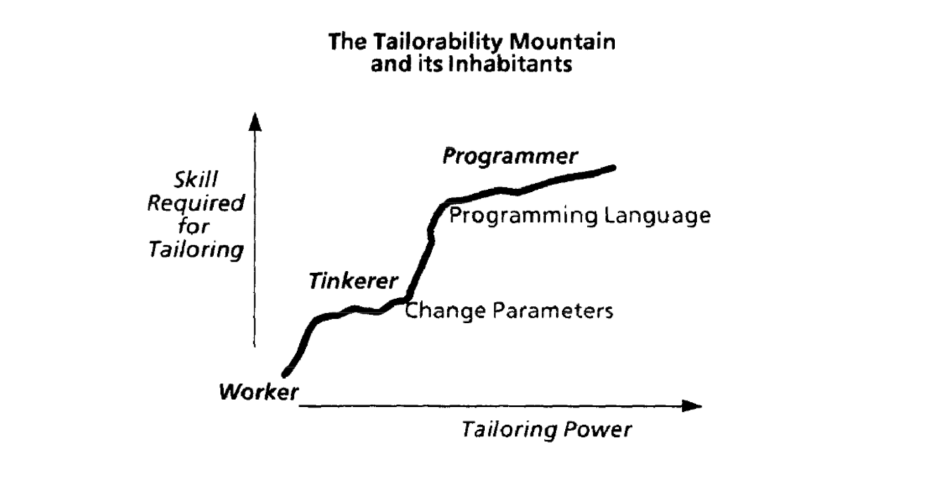
*Figure from MacLean et al.*[^17]
In that regard, AI is smoothing the current cliff. AI is definitely making it easier, on a broad scale, to get some sort of customisation.
Now any idea is almost a prompt away. Here is an example of how the enshittified YouTube experience led Karpathy to build HackerTube, a YouTube-like platform.[^18]
![[Casa essay - Karpathy HackerTube.png|350]]
## So what can we do (from a consumer standpoint)?
With AI, I believe we can rethink the tools that we use and not tolerate a negative value ratio.
The core needs of each product are usually met by a handful of features that were there in the early days (following the 80/20 Pareto rule). What I suggest to users is to identify most of the apps they use and see whether they can rebuild them (if they are willing to).
I foresee there will not be a SaaSpocalypse, but the new dominant design[^19] (and key success factor for tech companies) will be how to enable consumers to build and integrate their OS within current ecosystems.
Here Mark Zuckerberg shares how, with Muse, you can create such experiences.[^20]
![[Screenshot 2026-11-14 at 16.28.16.png|350]]
Notice how Muse leverages skeuomorphism again!
I personally embrace the concept of malleable software: **"a software ecosystem where anyone can adapt their tools to their needs with minimal friction"**.[^17]
In the sense that they become personal and adapt to the unique ways each of us is wired.
To move out of a locked-down app ecosystem, personal agency is needed.
As a side note, the problem with consumer-built OSes (by which I mean an ecosystem of solutions) is not coding per se, but that they require systems thinking, both from a product perspective (e.g. knowing the same behaviour techniques used by tech companies to incentivise a behaviour, often misused to create addiction, conversely here in a positive fashion) and from a tech one (how to maintain an app and keep it secure).
## On Meaning
With AI, CLIs have become popular again, as they focus on the objective to be done without clutter.
![[Casa essay - Claude Code CLI.png|400]]
*Source: Claude*[^21]
What won the product market in the 2010s were products that achieved what Steve Jobs said about the Mac OS X interface in 2000:[^22]
> "We made the buttons on the screen look so good you'll want to lick them."
"The experience is the product":[^23] the greater it is to look at, the better the experience.
In the 2020s, a product that looks good is taken for granted; what users expect is personalisation.
An experience that blends custom insights leveraging LLMs with a meaning-centered GUI: something that is a point of reference and makes the user feel safe.
Note: here I am talking about products that are used on a consistent basis.
The role of design is changing: from providing utility (remember the switches of the Soviet computer), to engagement (the latest mobile OS), to providing meaning.
And meaning is a form of skeuomorphism, but it talks about our worlds.
It is now a widely recognised design trend that nostalgia is becoming a feature.[^24] While everything is changing and uncertain, the fond memories and objects of our past make us feel safer.
The next class of consumer apps will be built with this concept embodied, and will have on top of them an ethical dimension: they are built to satisfy the needs of the user without abusing their trust.
We spend more time in front of a laptop than in most rooms of our home. Yet the experience we have is far from a cozy environment that makes us feel at home.
Casa is exactly this: a cozy, skeuomorphic pixel-art room.
![[Casa essay - room.webp|600]]
*Casa, the room*
There are two design styles that interlock:
- Skeuomorphism: to create meaning (screen above).
- Flat design: used for functional items (e.g. the agenda).
![[Casa essay - agenda.webp|600]]
*Casa, the agenda*
## Principles of modern product management
After this analysis, I introduce what I believe each of us should keep in mind when building a tech product:
1. **Protect the core.** The core of a product is a handful of features, usually from the early days (80/20), that address its core needs. This point also includes privacy and safety considerations.
2. **Respect the utility ratio.** Design for the activity: past the optimal ratio, more time spent is negative value.
3. **Make it malleable.** Let users adapt the tool to their needs with minimal friction, so they can move out of a locked-down ecosystem.
4. **Design for meaning.** Flat design for functional items, skeuomorphism that talks about the user's world.
5. **Earn trust, never exploit it.** Use behaviour techniques in the user's favour, and satisfy their needs without abusing their trust.
![[Casa essay - principles.png|600]]
## On Casa App
Casa App embraces the concept of malleable software. While being distributed as an Obsidian plugin, it is written in plain JavaScript with no dependencies, and its source is available: users are free to rebuild it for non-commercial use.[^25]
Download Casa for free: [casa.adrianofontanari.com](https://casa.adrianofontanari.com/)
This essay, a product manifesto, is more than a way to introduce Casa App: it is a fundamental product philosophy I wanted to share with the world.
If you have any feedback, feel free to contact me at [adrianofontanari.com](https://adrianofontanari.com/).
*Views are my own.*
---
## Sources
[^1]: [Wikipedia, "Setun"](https://en.wikipedia.org/wiki/Setun#/media/File:Setun_computer,_from_Sputnik_in_1959.png): first model assembled at Moscow State University in 1958.
[^2]: [Setun-70 emulator](https://zaneham.github.io/setun70-emulator/web/), reconstructed from 1970 Soviet archives (Brusentsov, Zhogolev, Maslov).
[^3]: [Wikipedia, "Unix"](https://en.wikipedia.org/wiki/Unix): development started in 1969 at Bell Labs (Ken Thompson, Dennis Ritchie and others). See also [Wikipedia (IT), "Unix-like"](https://it.wikipedia.org/wiki/Unix-like). Image: [UNIX System III on SIMH, by Rwoodsmall, 2019, CC BY-SA 4.0, via Wikimedia Commons](https://it.wikipedia.org/wiki/Unix#/media/File:Simh-pdp11-unix-sysiii.png).
[^4]: [Wikipedia, Windows 95 screenshot](https://upload.wikimedia.org/wikipedia/it/6/6a/Windows95.PNG)
[^5]: [Josh Carter, Paradigm concept book](https://joshcarter.com/magic_cap/paradigm_concept_book/): dated between late 1989 and early 1990, made by Marc Porat to pitch Paradigm inside Apple.
[^6]: [Wikipedia, "General Magic"](https://en.wikipedia.org/wiki/General_Magic): Paradigm started inside Apple in 1989 and was spun off as General Magic in May 1990 (Marc Porat, Andy Hertzfeld, Bill Atkinson). [Computer History Museum, "Computing for the Whole World: A Conversation with iPod & iPhone Inventor Tony Fadell"](https://computerhistory.org/?p=3688), 31 May 2017: Fadell and Rubin sat a few cubicles apart at General Magic and "would become instrumental in creating the iPhone and Android platforms".
[^7]: [Wikipedia, Magic Cap OS screenshot](https://upload.wikimedia.org/wikipedia/en/6/69/Magic_Cap_OS.gif). [Wikipedia, "Magic Cap"](https://en.wikipedia.org/wiki/Magic_Cap): first released 28 September 1994; "None of these devices were commercial successes."
[^8]: [Adafruit, "Magic Cap: the smartphone OS from the 90s"](https://learn.adafruit.com/magic-cap-the-smartphone-os-from-the-90s?view=all)
[^9]: [Wikipedia (IT), "Microsoft Bob"](https://it.wikipedia.org/wiki/Microsoft_Bob). [Wikipedia, "Microsoft Bob"](https://en.wikipedia.org/wiki/Microsoft_Bob): released 10 March 1995, discontinued in early 1996.
[^10]: [VirtualDJ](https://it.virtualdj.com/)
[^11]: [El Nacional, skeuomorphism and iOS 7](https://www.elnacional.cat/es/tecnologia/esqueumorfismo-apple-ios-7_1557827_102.html)
[^12]: [Apple Newsroom, iOS 18, June 2024](https://www.apple.com/it/newsroom/2024/06/ios-18-makes-iphone-more-personal-capable-and-intelligent-than-ever/)
[^13]: [Wikipedia, "Enshittification"](https://en.wikipedia.org/wiki/Enshittification): term coined by Cory Doctorow in November 2022; American Dialect Society Word of the Year 2023.
[^14]: Lord Acton, letter to Mandell Creighton, 5 April 1887: "Power tends to corrupt and absolute power corrupts absolutely." ([Wikiquote](https://en.wikiquote.org/wiki/John_Dalberg-Acton,_1st_Baron_Acton))
[^15]: [Melnick et al., Mayo Clinic Proceedings](https://doi.org/10.1016/j.mayocp.2019.09.024), published online November 2019: 870 US physicians rated EHR usability 45.9/100 (grade "F"); each point of better usability came with 3% lower odds of burnout. Cross-sectional study: association, not causation. Image: [EMRSystems, Epic EMR software page](https://emrsystems.net/epic-ehr-software/) (the site labels it Epic; the screen shows a Cerner test patient).
[^16]: [R. Scott Evans, "Electronic Health Records: Then, Now, and in the Future", Yearbook of Medical Informatics, 2016](https://pmc.ncbi.nlm.nih.gov/articles/PMC5171496/): by 1992, EHRs were "based around billing and scheduling systems, some clinical systems"; others (COSTAR, PROMIS, TMR, HELP) were built as clinical systems from the start.
[^17]: [Geoffrey Litt, Josh Horowitz, Peter van Hardenberg, Todd Matthews, "Malleable software", Ink & Switch, June 2025](https://www.inkandswitch.com/essay/malleable-software/). The quote and the definition are theirs. The figure is from MacLean et al., "User-Tailorable Systems: Pressing the Issues with Buttons", 1990.
[^18]: [Andrej Karpathy on X, 1 November 2026](https://x.com/karpathy/status/2116957135661945283): "I was annoyed with YouTube's recommendations so I had Claude filter down 43M comments over 20 years of HN".
[^19]: [James M. Utterback and Fernando F. Suárez, "Patterns of industrial evolution, dominant designs, and firms' survival", 1993](https://www.researchgate.net/publication/37593841_Patterns_of_industrial_evolution_dominant_designs_and_firms'_survival) (MIT working paper, 1992).
[^20]: [Mark Zuckerberg on X, 6 November 2026](https://x.com/finkd/status/2118765774034579808): "tell Muse what you need and it builds it".
[^21]: [Claude, coding](https://claude.com/it/solutions/coding)
[^22]: Fortune, 24 January 2000, on the Mac OS X Aqua interface ([Wikiquote](https://en.wikiquote.org/wiki/Steve_Jobs)).
[^23]: [Peter Merholz, "The Experience is the Product", talk at Mind the Product San Francisco, write-up of 17 June 2016](https://www.mindtheproduct.com/experience-product-peter-merholz/): "We tend to forget that the experience is the product we're delivering."
[^24]: [Joe Smiley, "The most popular experience design trends of 2026", UX Collective, 26 January 2026](https://uxdesign.cc/the-most-popular-experience-design-trends-of-2026-3ca85c8a3e3d): "Nostalgia and familiar patterns are being used deliberately to create trust."
[^25]: [Casa on GitHub](https://github.com/adrianofontanari/casa): source-available under the PolyForm Noncommercial License 1.0.0, with an added permission for use at work. Images of Casa: the free plugin with sample data.